
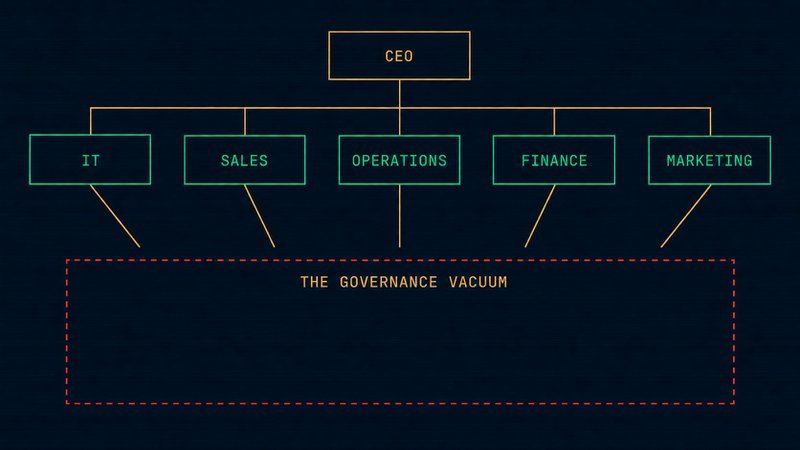
Recent research from BCG shows that about seventy percent of large digital transformation programs miss their targets. Across departments, they fail because Digital Transformation Governance falls into a governance vacuum in which no one owns cross‑functional outcomes.
Picture a Riyadh executive with Vision 2030 targets on the board scorecard. Budget is approved, licenses paid, and integrators on site. The ERP works, the cloud runs, yet orders still bounce between Finance, Operations, and IT.
In that gap sits the same governance vacuum, where every department holds a piece of the mandate, and no one owns the result. This article is the pre-kickoff guide. Six sections, in the order they have to be understood, before any digital transformation steering committee holds its first meeting.
What the Digital Transformation Governance Vacuum Actually Is

A governance vacuum is the unowned space between two departments that both contribute to a transformation outcome, but neither commands it.
Consider an enterprise rolling out an integrated customer platform. IT owns the system. Sales owns the customer relationship. Operations owns the fulfillment process. Finance owns the cost center. Marketing owns the brand experience.
Five owners. No owner.
When the program stalls — and it always stalls somewhere — five departments each have a defensible reason it is not their fault. The technology works as specified. The sales targets are being met. Operations is processing tickets within SLA. Each function passes the audit. The transformation still fails.
Three symptoms tell you a governance vacuum is forming:
- Steering committee meetings get longer, not shorter. Decisions are debated, deferred, and re-debated.
- Status reports use the passive voice. “It was decided,” “the integration was delayed,” “concerns were raised.” No subjects.
- Escalations stop reaching the CEO. Issues circulate horizontally among department heads rather than climbing.
If your program shows two of those three, the vacuum is already costing you money. The third is just the honesty arriving late.
The Accountability Gap: Everyone Responsible, Nobody Accountable

The single most expensive failure mode in digital transformation accountability is the RACI matrix that lists six “Responsible” parties and zero “Accountable” individuals.
Responsibility is plural. It can be shared. Accountability is singular. It cannot. When a deliverable lists three accountable owners, you do not have triple coverage. You have zero coverage with three excuses.
Gartner’s research on transformation programs has reported the same finding for years: the strongest predictor of program success is not budget, technology stack, or vendor selection. It is the existence of a single named individual with the authority to halt or accelerate the program without consulting a committee.
Research from McKinsey shows that programs with clear senior accountability realize far more value from the same level of digital spend — in some studies delivering up to 2.5 times more measurable ROI than those without designated outcome owners.
The hard test for any transformation governance model: ask anyone in the organization who owns the program. If three people answer with three different names, the vacuum is already open. Close it before kickoff or pay to close it afterward at three to five times the cost.
Why GCC Organizational Structures Create Specific Digital Transformation Challenges
The GCC digital transformation challenges that derail Saudi and Gulf programs are not the same as those in Western enterprises, and copying a McKinsey or BCG generic governance template into a Riyadh family business creates new failure modes rather than solving the existing ones.
Three structural realities matter here:
- Hierarchical decision-making cultures. In many GCC enterprises, decisions of substance reach the CEO or chairman regardless of formal delegation authority. A steering committee that is supposed to decide will instead recommend, and the actual decision happens upstairs without the committee in the room.
- Family-business overlay. In privately held GCC enterprises, family members occupy executive roles that do not always match formal organizational charts. Governance models that ignore this create theatrical committees that decide nothing.
- Vision 2030 timeline pressure. National programs operate on calendar deadlines that do not flex. When a Vision 2030 KPI is at stake, governance discipline often gets traded for delivery speed — and the vacuum forms in the trade.
BCG’s GCC Digital Index has consistently found that GCC enterprises move faster than their global peers in technology procurement but slower in organizational realignment. The gap is the vacuum.
The implication is direct: copying and pasting a generic governance template into a GCC enterprise is worse than having no governance model at all. The model has to be designed for the actual decision-making culture, not the one written on the org chart.
The Digital Transformation Steering Model That Actually Works
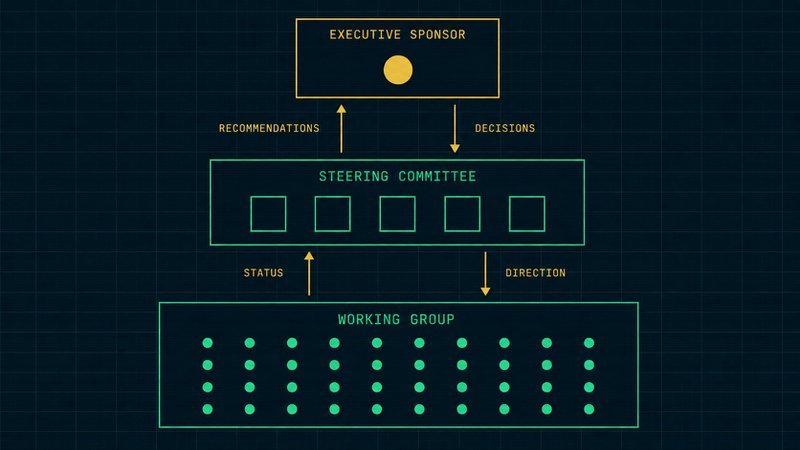
A working digital transformation steering committee has three layers, not one. Most failed programs have only the middle layer.
| Layer | Decision Rights | Cadence |
|---|---|---|
| Executive Sponsor | Owns outcome KPIs, breaks cross‑departmental deadlocks, reallocates budget and ownership when needed. | Meets monthly or on major milestone, can call ad hoc meetings for crises. |
| Steering Committee | Approves scope, timeline, and key design choices, signs off risks, cannot push decisions downward. | Meets every two weeks to review progress, risks, and escalations. |
| Working Group | Runs day‑to‑day delivery, manages detailed plans, prepares options for Steering Committee decisions. | Meets weekly, tracks tasks, raises blockers with a proposed resolution. |
The model fails when these three layers collapse into one — when the steering committee tries to be both decision-maker and execution body. That is the most common pattern in stalled GCC transformations, and it is the easiest one to fix before kickoff.
The KPIs That Force Digital Transformation Governance Clarity

Activity KPIs measure motion. Outcome KPIs measure progress. Most failed programs are rich in activity metrics and starved of outcome metrics.
Five outcome KPIs that surface governance failure early enough to fix:
- Decision cycle time — number of days between an issue surfacing and a documented decision being made.
- Escalation rate — percentage of steering committee items that required executive sponsor intervention.
- Cross-functional delivery rate — percentage of milestones met that required two or more departments to coordinate.
- Adoption velocity — percentage of intended end-users actually using the new system 30/60/90 days after go-live.
- Steering committee attendance ratio — quietest signal of all. When the committee starts sending deputies, the program is already losing executive sponsorship.
If any of those five trends are in the wrong direction for two consecutive review cycles, the governance model is failing — not the technology, not the team, not the vendor.
The 4 Governance Decisions to Make Before Kickoff

These four decisions are the entire pre-kickoff governance brief. If they cannot be answered in writing, the program is not ready to start, regardless of what the Gantt chart says.
- Who is the single named executive sponsor, and what authority do they hold? Not a title. A name. And the explicit answer to: can this person halt the program tomorrow without convening anyone?
- What is the steering committee charter? Membership, cadence, decision rights, and the explicit list of decisions reserved for the executive sponsor versus the committee.
- What is the decision rights matrix? A program-specific RACI for the top fifty decisions the program will face, populated with names and resolved before kickoff.
- What is the escalation and unblock protocol? When the steering committee cannot decide, what is the path, who is consulted, and what is the maximum time an issue can sit unresolved? The answer should be measured in days, not weeks.
If those four documents do not exist on the day of kickoff, you are not running a program. You are funding one.
How Jood Alliance Closes the Governance Vacuum in Saudi Enterprises

Jood Alliance was created in Riyadh to close exactly this gap for mid-to-large GCC enterprises. The firm’s Outcome-Driven Planning method begins by naming the executive sponsor, drafting the steering committee charter, and building the decision-rights matrix — all before any technology architecture conversation.
For Saudi enterprises operating under Vision 2030 timelines, this discipline is the difference between a transformation that produces a measurable national program contribution and one that produces a press release followed by silence.
The work is unglamorous. The pre-kickoff governance design is the part of the program no vendor will sell you, no consultant will spotlight in their case study, and no annual report will celebrate. It is also, almost without exception, the part that determines whether the rest of the program is real.
If you want to explore related perspectives, the digital transformation insights hub provides additional executive-level guidance.
For delivery execution, these foundation layers typically matter first:
- Network automation for reliable operations at scale
- Cloud computing programs with governance and cost control
- Industrial IoT architectures for operational visibility
The Question Worth Asking Before Kickoff
Most failed transformation programs in the GCC were not killed by competitors, technology shifts, or budget cuts. They were killed in the empty space between two departments, eighteen months before anyone admitted it.
For the rest of Jood Alliance’s Leadership pillar series and the free readiness diagnostics rolling out across 2026, see tools.joodalliance.com.
FAQs
What is digital transformation governance?
Digital transformation governance is the documented system of decision rights, accountability, and escalation paths that controls how a transformation program is planned, executed, and adjusted. A working governance model names a single executive sponsor, defines a cross-functional steering committee charter, and resolves the program’s top decisions in writing before kickoff.
Why do digital transformation projects fail?
Most digital transformation projects fail because of a governance vacuum, not a technology failure. The technology works as specified, the budget is approved, and the vendors deliver — but no single individual is accountable for the cross-functional outcome, so the program stalls in the empty space between departments.
What is digital transformation accountability?
Digital transformation accountability is singular, not plural. It is the assignment of one named individual with the authority to halt, accelerate, or change a program without committee consent. Shared accountability across multiple owners is functionally equivalent to no accountability at all.
What does a digital transformation steering committee actually do?
A working digital transformation steering committee surfaces issues to the executive sponsor with a recommendation, monitors the cross-functional progress of the program, and protects the working group from political interference. It does not vote, decide unilaterally, or replace executive sponsorship.
What are the biggest GCC digital transformation challenges?
The three most common GCC digital transformation challenges are: hierarchical decision-making cultures that bypass formal governance, family-business overlays that do not match published org charts, and Vision 2030 timeline pressure that trades governance discipline for delivery speed. Generic Western governance templates often fail in this environment.